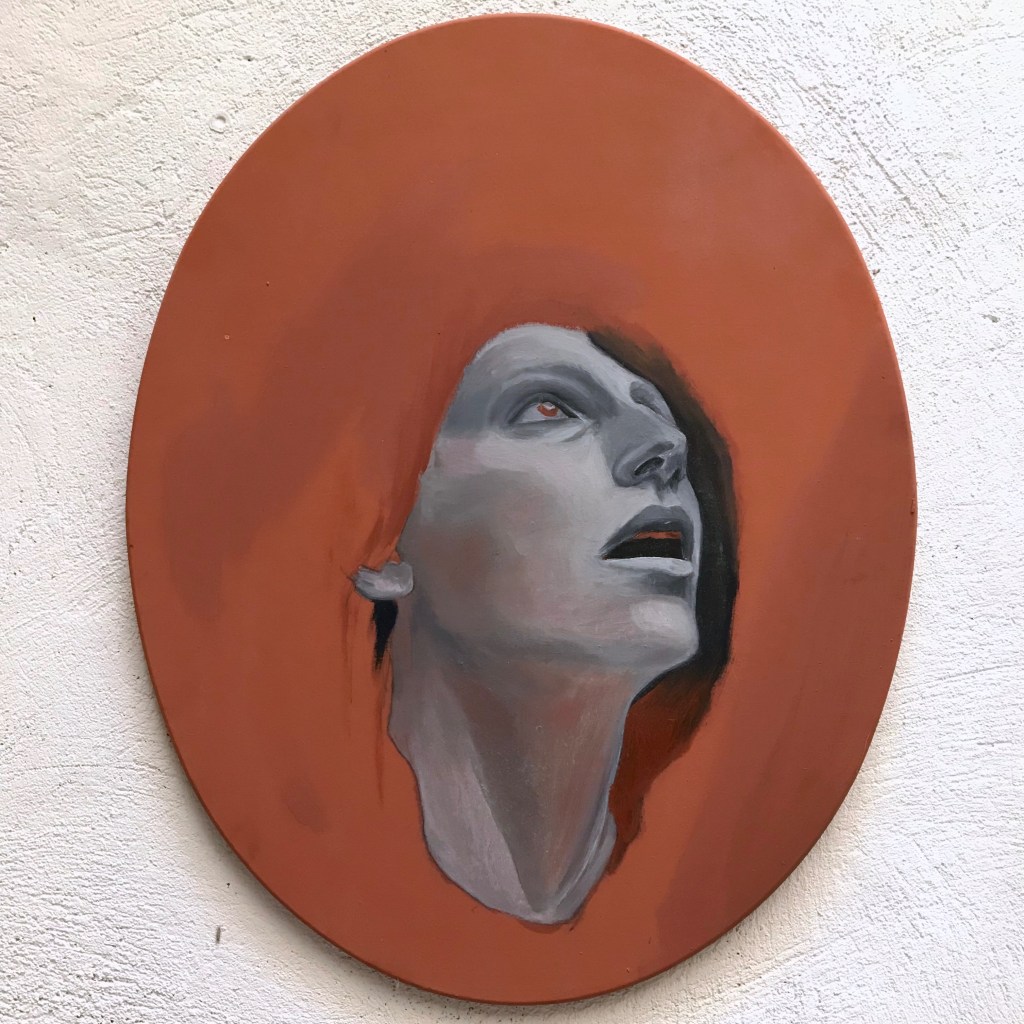
diana hajji / paintings / cyrille putman gallery
why are diana hajji’s new paintings so intriguing?
could it be because they seem to hover between a fictitious ‘inside’ and a luminously transparent ‘outside’, seducing us into accepting that either one could well be the truly authentic state we seek to inhabit?
or is it because they firstly tempt us to venture through the liminal into the not-known only to then encourage us to take refuge once more in the known.
but then the level of conviction required to commit to a permanent stay in either dimension can depend on the kind of nightly dream-world your unconscious has been conjuring up lately or on how poignantly you’re missing that special person right now or perhaps even on how far you might currently be from your longed-for home.
hajji’s new paintings certainly have the urgent quality of half-glimpsed dreams but also of barely recalled memories, like the blazing sunset you glimpsed as you negotiated that last bend and headed deeper into the dark mountains, leaving behind you both the sea on fire and the multicoloured misty autumn morning you experienced as a child.
and as you look harder inside each painting attempting to reconcile this disconnect between seen and felt, each painted surface suddenly seems to zoom forward right up to your eyelids activating the tactile capacity of your embodied self; at once what was mist becomes so many unnamed hues of prussian blue impasto and the evening sky that seemed to have been on fire just a few seconds ago is suddenly revealed as simply inert coloured matter.
i recall hearing somewhere that the artist had in her prime studied chemistry and painting in moscow, the beaux arts in nimes and photography in arles, before devoting herself to the alchemy of painting practice right in the city where vincent van gogh first experienced the ephemerality of light.
so as you stand inside cyrille putman’s tiny arlesian gallery on a late summer evening considering all this you suddenly come to understand that hajji’s paintings function as portals, as the very thresholds that mark the liminal space through which flows the endless communion between matter and non-matter (or light and darkness), the ultimate transmutation between embodied experience and its consequent mindfulness.
the incessant dissolution between being and non-being that seems to take place here (and in a kind of way actually does) constitutes the connective action that allows us to enter each portal from either side and subsequently move through to its opposite, returning as many times as we care to.
do you get all this from standing in front of a few small paintings, you might say? but, i may well respond, isn’t this what art does, or at least what it’s supposed to do, transforming our sense of the world as-it-is into something new and unknown, revealing through this process what’s been hidden under the deceptive veil of appearances and consequently offering a newly-unmasked world to both our intellect and senses.
the most potent art invites us to venture through such liminality, never to return un-transformed.
domenico de clario
june 14 2025
 Diana Hajji